NYC Artist Coalition / FairRentNYC
Cultural-space advocacy, coalition memory, and Commercial Rent Stabilization
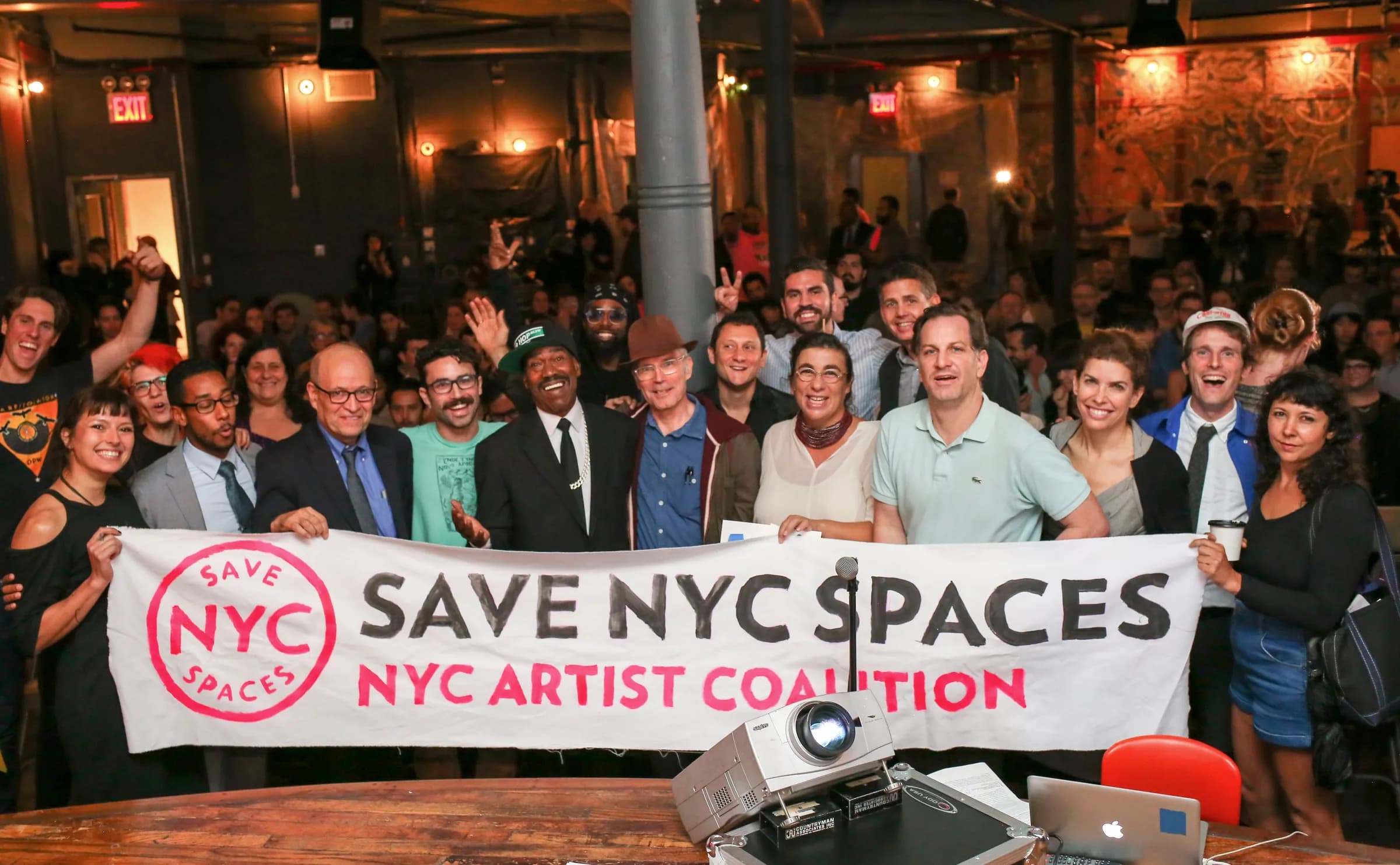
As a founding member and organizer of NYC Artist Coalition, implemented and maintained campaign websites and helped build coalition memory, source maps, and coordination infrastructure for cultural-space advocacy, FairRentNYC, Commercial Rent Stabilization, and storefront stability.
What to know first
- My responsibility
- Co-Founder, Civic Systems, Coalition Operations & Policy Communications Lead
- What became usable
- Recurring cultural-space meetings, public event pathways, practical safety and legal sessions, town halls, hearings, campaign actions, running minutes, action trackers, source maps, public campaign websites, and shared campaign memory.
- Evidence to inspect
- Founding-member and organizer role in NYC Artist Coalition
- Civic systems, coalition operations, and policy-communications infrastructure
At a glance
- Role
- Co-Founder, Civic Systems, Coalition Operations & Policy Communications Lead
- Years
- 2017-Present
- Context
- Civic Systems
- Status
- Full case study
- Visibility
- public-safe
- Role fit
- Civic delivery, coalition operations, product operations, documentation architecture, source-backed memory, public guidance, policy communications, and implementation support.
Context
NYC Artist Coalition, FairRentNYC, and Commercial Rent Stabilization work brings together cultural-space advocacy, storefront stability, public policy, city and state strategy, legal questions, lived experience, and public data. With many collaborators and mixed public/private sources, the operating challenge was to preserve decisions and momentum without exposing strategy, legal-review context, private stakeholder information, or unapproved quotes.
Here, documentation is infrastructure: the shared place where meetings, sources, open questions, decisions, and next steps remain usable over time.
Documented organizing and testimony
Official Council testimony and public reporting document Jamie organizing fire-safety walk-throughs, workshops, and Fire Guard study groups for DIY venues, then advocating for full repeal of the Cabaret Law.[1][2]
NPR described Jamie as a founding member of NYC Artist Coalition; contemporary local reporting also identified him as an organizer and documented the coalition's mutual-aid and public-advocacy work.[3][4][5]
Beginning in 2017, Jamie helped establish and produce NYC Artist Coalition's recurring participation system. Listening meetings and priority ballots became run-of-show documents, call scripts, public event pages, practical safety and legal sessions, town halls, hearings, campaign actions, and sustained follow-through across small cultural spaces and City Hall.[21][1][7]
The public event layer also carried visible platform traction: 19 recovered event pages display at least 100 Facebook responses, seven at least 500, and three at least 1,000. These are historical response labels, not verified attendance or unique reach.[21]
NYC Artist Coalition then spearheaded a public town hall about what communities needed from the new Office of Nightlife. Public reporting names Jamie among the coalition speakers; a protected run-of-show also documents Jamie and Olympia Kazi opening the program within a larger shared production plan.[6][7]
In 2018, Jamie testified before the Council's Committee on Small Business in support of commercial rent protections, connecting affordability to the safety and continuity of neighborhood cultural spaces.[8]
Together, these sources establish Jamie's organizing, testimony, coalition infrastructure, and public-communication work. They do not turn Cabaret Law repeal, NYC Artist Coalition, the Office of Nightlife, or commercial-rent advocacy into one person's accomplishment.
What I did
Retained Git history documents Jamie's direct implementation and maintenance of FairRentNYC, Talks Not Raids, Let NYC Dance, and the coalition site's Ghost deployment. Campaign positions and outcomes remained collective.[9][10]
Jamie built and stewarded 30+ pages of shared campaign-memory and coordination infrastructure, synthesizing meetings, decision records, action items, legal and policy questions, media assets, stakeholder next steps, and city and state strategy lanes into actionable workstreams.
Jamie created a legislative source map and provenance redline tracing Commercial Rent Stabilization bill language across 2019, 2022, and 2025 policy lineages and revision paths.
The documentation architecture separated supported public material from open questions and protected context. Collaborators could orient after meetings, recover source context, track next steps, and prepare public explanations without treating private coordination as publishable content.
Jamie recalls that at a July 2017 coalition meeting at Shoestring Press, participating groups aligned around a shared Let NYC Dance site and email list. Retained repository histories separately establish his implementation and maintenance of the campaign web infrastructure.[24][9][25]
Public systems / lived participation
The website was one part of the room
A shared public surface, a facilitated working session, and a civic gathering are three interfaces to the same operating challenge: help many people understand the work, coordinate, and participate.
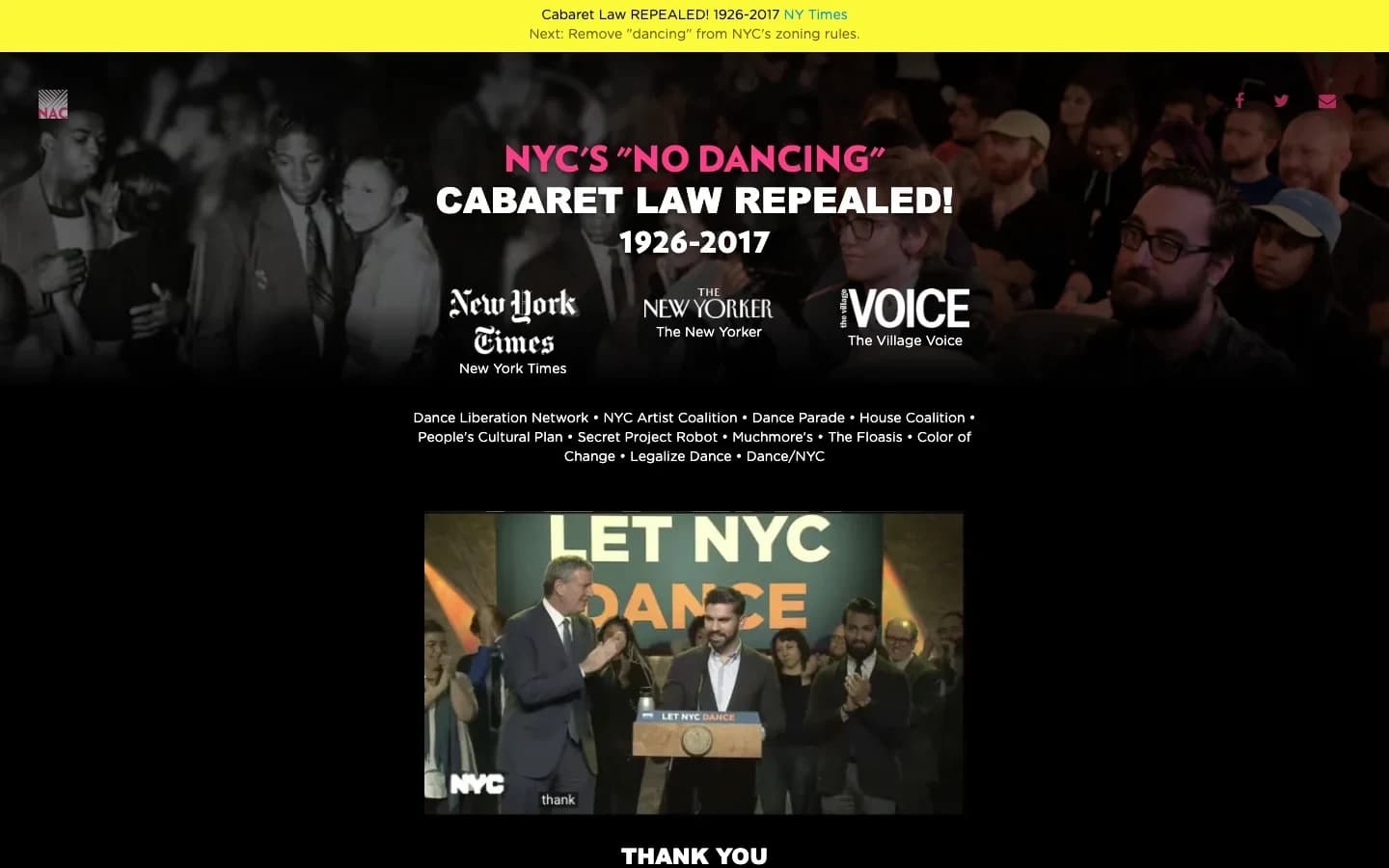
01 / Shared public surface
LetNYCDance.com joined an issue explainer, Council contact path, public data, progress, coalition credit, and source links in one action-oriented campaign interface. The embedded video is shown during the mayoral bill signing; this frame was selected from a ten-second opening study after the player controls cleared. Captured August 13, 2026.
02 / Working alignment
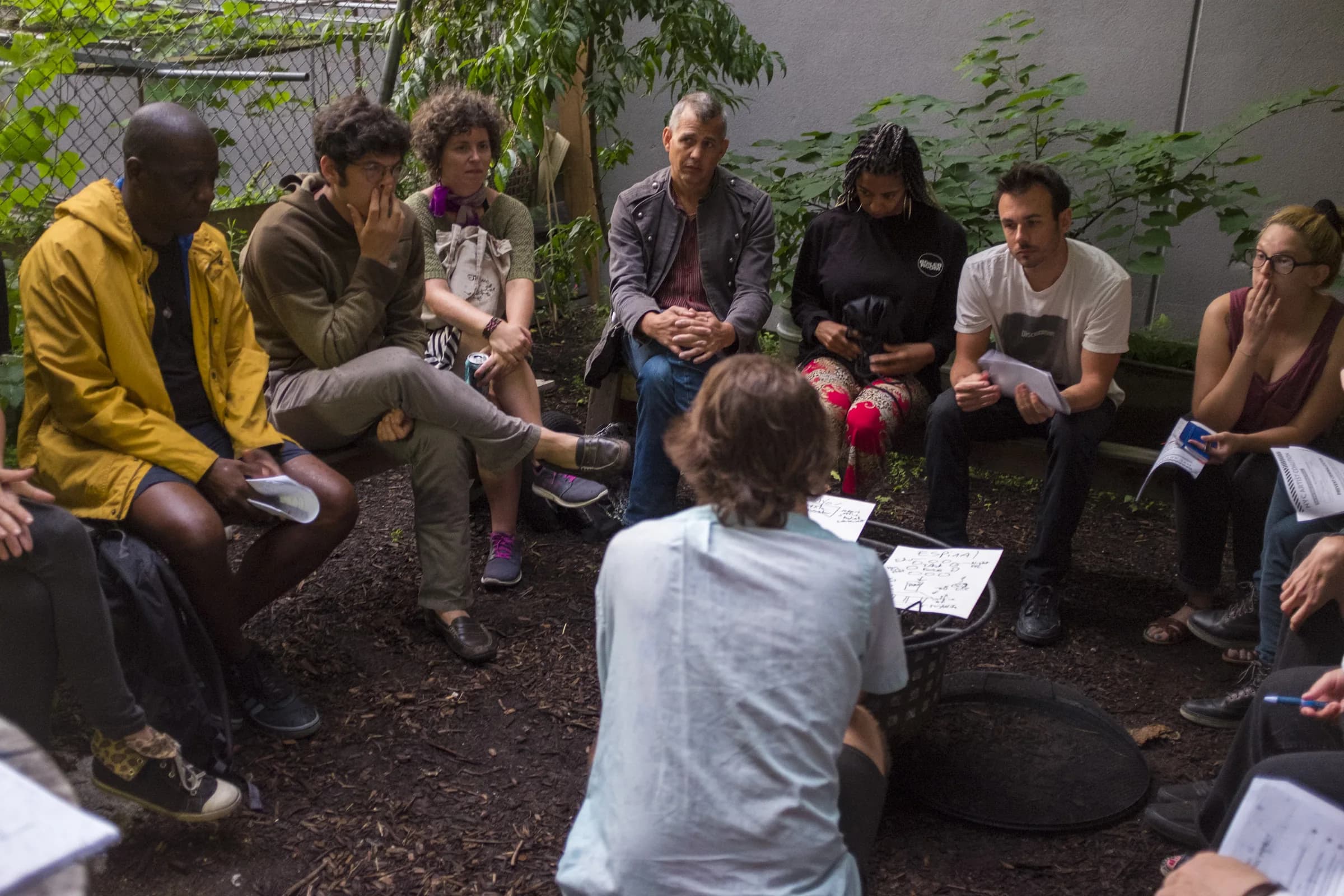
Jamie recalls this coalition meeting as the point when participating groups aligned around a shared campaign site and email list. The retained web histories separately establish his implementation and maintenance of the campaign infrastructure; the policy outcome and movement remain collective.
03 / The public room
01
Align
Make the shared question and decision visible.
02
Translate
Turn policy and public data into a clear action path.
03
Implement
Build one maintained surface people can use together.
04
Sustain
Carry context across the room, list, sources, and follow-up.
What became usable
Together, these systems supported coalition continuity, public communication, and reviewable source trails across complex civic work.
A complete capture-date pass of the surviving NYC Artist Coalition Facebook feed preserves 445 dated posts from 2017-2021, with public-safe source routing and shared-account authorship boundaries.[22][23]
A July 2026 archival pass reviewed every one of the 3,123 unique public records X made retrievable from the coalition account: 685 coalition-account-authored originals or replies and 2,438 external-source posts surfaced through native reposts. The corpus preserves four campaign lines and a broad arts, labor, small-business, tenant, legal, public-sector, and journalism source network. X's timeline limits leave 2,001 profile-counted records outside the public capture, so this is a complete review of the retrievable union, not a complete account export.[18][19][20]
The coalition's shared public identity carried four campaigns across multiple policy cycles. A targeted review recovered posts by at least six serving Council member accounts that directly mentioned @NYCArtC, while individual coalition-post authorship remains deliberately unattributed.[15][16][17]
Jamie implemented and maintained Talks Not Raids, giving the coalition's demand for transparency and alternatives to raids a durable public campaign site. The campaign concerned Multi-Agency Response to Community Hotspots (M.A.R.C.H.), an NYPD-led inspection program. The Council later required semiannual reports and 30 days' advance notice, with criminal-investigation and serious health-or-safety exceptions. The Office of Nightlife reports that the City replaced M.A.R.C.H. with direct engagement before enforcement in 2023.[9][11][12][13][14]
Outcome and proof
The campaign screenshot below demonstrates Jamie's public web contribution; the described running minutes, source maps, decision records, and action trackers demonstrate the operating system around that surface. Campaign accomplishments remain collective. This case does not claim that Jamie alone caused policy outcomes or provided official legal analysis.
For hiring teams, the work shows technical project management, coalition operations, documentation architecture, source-backed decision support, implementation, and disciplined handling of sensitive context.
Sources and notes
These notes preserve what each source supports and where its limits remain. See something that needs correction? Contact Jamie.
View 25 source notes
[1] Emma Whitford, 'DIY Venues Demand Repeal Of Widely Reviled Cabaret Law,' Gothamist, June 19, 2017.
Reports Jamie's fire-code study groups, City Hall repeal advocacy, NYC Artist Coalition identification, and public safety analysis.
Boundary: This source does not establish Jamie solely caused repeal, Jamie solely created NYC Artist Coalition, Jamie created the Office of Nightlife, every venue's safety experience.
Official transcript directly documenting Espinal's public reform frame and Jamie's coalition affiliation, repeal testimony, and fire-safety organizing; the transcript misspells his surname as Burkhart.
Boundary: This source does not establish Espinal's private motive, institutional dependency on the coalition, independent verification of the self-reported pass rate, sole authorship of the repeal campaign, sole causation of repeal, complete program participation or outcomes.
National reporting that describes Jamie as a founding member of 'NYC Arts Coalition' and quotes his community-space framing during the repeal campaign.
Boundary: This source does not establish Jamie as sole founder, Jamie's sole responsibility for repeal, individual authorship of coalition websites, creation of the Office of Nightlife.
Reports Jamie's organizer role, more than 100 mutual-aid signups, safety education, and coalition policy development.
Boundary: This source does not establish current coalition membership, long-term network participation, Jamie's sole leadership, adoption of the proposals.
[5] NYC Artist Coalition, 'Supporters List,' accessed July 13, 2026.
Names Jamie Burkart with WOW List and documents public-member and members-only mutual-aid intake options.
Boundary: This source does not establish founding status, leadership role, complete or dated membership, website authorship.
Reports that NYC Artist Coalition spearheaded the town hall, names Jamie and Olympia Kazi among speakers, and documents participation by cultural organizations and city officials.
Boundary: This source does not establish a complete production-credit roster, an audited attendance total, Jamie's sole production role, sole causation of legislation.
[7] Greene Hill Food Co-op, 'The Co-op Q&A With Jamie Burkart and Julie Fredenberg,' December 19, 2017.
Community profile connecting Jamie and Julia to NYC Artist Coalition advocacy, the Cabaret Law campaign, an Office of Nightlife town hall, Sunday Dinner, and WOW List.
Boundary: This source does not establish sole causation of Cabaret Law repeal, Jamie's causal role in creating the Office of Nightlife, attendance totals, sole ownership of collective projects.
[8] New York City Council Committee on Small Business hearing transcript, October 22, 2018, pp. 347-348.
Official transcript of Jamie's testimony as an NYC Artist Coalition member in support of commercial rent protections for cultural spaces.
Boundary: This source does not establish enactment of the bill, Council agreement with the testimony, Jamie's sole authorship of the policy position, measured causal effects of rent increases.
[9] Jamie Burkart retained campaign-site Git histories, author summaries and commit logs reviewed July 14, 2026.
The public note reports aggregate authorship evidence without exposing local paths, deployment remotes, credentials, or private repository contents.
Boundary: This source does not establish sole authorship of coalition positions, individual authorship of every line of copy or data, sole design authorship, sole causation of campaign or policy outcomes.
[10] openhouse/FairRentNYC public Git repository, accessed July 14, 2026.
Publicly inspectable repository preserving the FairRentNYC implementation and commit history.
Boundary: This source does not establish sole authorship of coalition policy, authorship of every campaign asset, policy causation, complete collaborator history.
City-preserved coalition artifact documenting collective recommendations, public-input pathways, and an early M.A.R.C.H. transparency proposal.
Boundary: This source does not establish individual authorship, adoption of every proposal, later Talks Not Raids campaign causation, attendance produced by the event links.
Official publication record defining M.A.R.C.H. as an NYPD-led multi-agency inspection program and preserving the first biannual reporting period under Local Law 220.
Boundary: This source does not establish complete data quality, independent program evaluation, advocate-specific causal credit, the experience or result of every operation.
[13] New York City Council, Int 1156-A, enacted as Local Law 220 of 2019, December 15, 2019.
Official legislative history establishing semiannual M.A.R.C.H. reporting, machine-readable public data, and 30-day notice with specified exceptions.
Boundary: This source does not establish which advocate caused enactment, complete implementation quality, elimination of M.A.R.C.H. in 2019, Jamie's authorship of the bill.
[14] NYC Office of Nightlife, 'Annual Report 2023-2024,' p. 11.
Official report stating that CURE replaced M.A.R.C.H. operations in December 2023 and describing direct communication before enforcement.
Boundary: This source does not establish sole causal credit for any advocate, universal implementation, outcomes for every venue, that M.A.R.C.H. ended before December 2023.
[15] Portfolio social-media archival production inventory, July 15, 2026.
A reproducible inventory of recovered public account profiles, posts, repost lists, interaction edges, source articles, and explicit stopping conditions.
Boundary: This source does not establish a complete lifetime archive, individual authorship of shared-account posts, unobserved likes, endorsement from every interaction, that an unrecovered account never existed.
[16] NYC Artist Coalition (@NYCArtC), public X profile, accessed July 15, 2026.
The profile explicitly names Save NYC Spaces, Let NYC Dance, Talks Not Raids, and Fair Rent NYC as coalition campaigns.
Boundary: This source does not establish individual post authorship, Jamie's sole control, Olympia Kazi's authorship, sole causation of campaign outcomes.
[17] Daisy Prince, 'Taking back New York City's nightlife,' Document Journal, February 27, 2018.
The article identifies Jamie and Olympia Kazi with NYC Artist Coalition, documents the coalition's public context, and preserves separate participant voices; it misspells Jamie's surname as Burkhart.
Boundary: This source does not establish individual authorship of @NYCArtC posts, Jamie's sole founding role, Olympia Kazi's sole control of the account, sole causation of policy outcomes.
[18] NYC Artist Coalition X retrievable-population manifest, July 15, 2026.
A public-safe 3,123-row manifest preserving source-status URLs, source-post dates, author handles, record types, link metadata, mention handles, hashtags, classification digests and first matches, incoming mentions from the defined query window, and dated aggregate counts. Raw post text, credentials, cookies, private account state, and session data are excluded.
Boundary: This source does not establish the content of 2,001 profile-counted records outside the recovered public union, individual authorship of the shared account, engagement by every reposted source account, reach, endorsement, participation, policy causality, or impact.
[19] X Help Center, 'Help with missing Posts,' accessed July 15, 2026.
X documents that Posts displays the latest 800 records, Posts & replies displays the latest 3,200, and older posts may fail to appear because of indexing restrictions.
Boundary: This source does not establish which @NYCArtC records fall outside the limits, that an unmaterialized record was deleted.
[20] X Help Center, 'New user FAQ,' accessed July 15, 2026.
X directs account owners beyond the recent profile timeline to download an X Archive and browse account information beginning with the first post.
Boundary: This source does not establish the contents of the @NYCArtC owner archive, exact reconciliation to the current profile counter.
Retains 33 event identities, dates, venues, organizer displays, time-stamped response snapshots, topics, source routes, and public-safety dispositions without raw descriptions or participant and access data.
Boundary: This source does not establish the unresolved event identity, every historical coalition event, individual event authorship or production, physical attendance or unique people, policy causality, permission to publish attendee identities, comments, contacts, or credentials.
[22] NYC Artist Coalition Facebook post full-population public-safe census, July 15, 2026.
A 445-row ledger of dates, unique one-way reconciliation hashes, source-route keys, defined mission, stakeholder, and account-reference tags, content hashes, and displayed interaction counts. Raw bodies, underlying reconciliation identities, social-graph identities, authenticated URLs, and sensitive exact routes are excluded.
Boundary: This source does not establish complete lifetime account history, post-level human authorship, incoming engagement by named stakeholder groups, reach, attendance, conversion, endorsement, mandate, policy impact.
[23] NYC Artist Coalition Facebook post archival-production report, July 15, 2026.
Documents method, population reconciliation, source routing, stakeholder and interaction semantics, shared-account credit, privacy controls, and projection decisions.
Boundary: This source does not establish a native Meta export, individual post authorship, complete deleted-post recovery, causal impact.
[24] Jamie Burkart first-person account and portfolio-use authorization, August 13, 2026.
The capsule records Jamie's recollection and authorization boundaries without correspondence, Apple Photos identifiers, People tags, or location coordinates.
Boundary: This source does not establish independent collaborator corroboration of the meeting agreement, permission for other destinations, permission to expose private metadata, sole authorship or causation.
[25] NYC Artist Coalition project photograph of a July 24, 2017 working session at Shoestring Press; portfolio use authorized by Jamie Burkart.
The metadata-stripped portfolio derivative excludes private archive identifiers, People tags, and location coordinates.
Boundary: This source does not establish exact remarks, meeting decisions, endorsement, policy causation.
Primary artifacts
- website
- source map
- meeting memory
- decision record
- public handout
Artifact gallery
meeting memory / 01
Campaign-memory spine
A shared documentation structure for meetings, next steps, decision context, and public-safe continuity.
source map / 02
Source map
A structured way to separate public sources, private notes, open questions, and materials that require review.
decision record / 03
Policy question log
A working list of unresolved legal, policy, city, and state questions for collaborators to review.
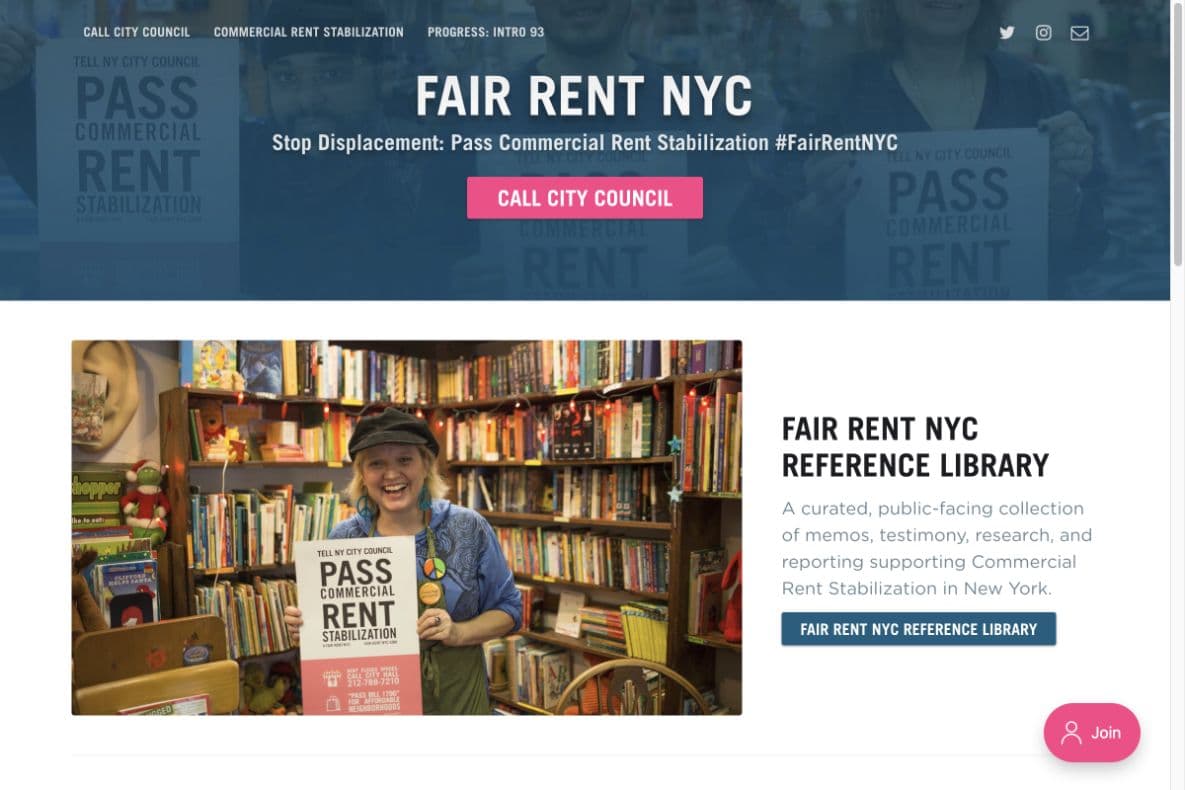
website / 04
Public campaign web surfaces
Public-safe website infrastructure for NYC Artist Coalition advocacy, FairRentNYC, Talks Not Raids, and Let NYC Dance.
FairRentNYC public campaign surface captured July 2026. The screenshot demonstrates public web and resource-library infrastructure; campaign outcomes remain collective.
View FairRentNYC public websiteScope and sources
Known
Contemporary reporting identifies Jamie as a founding member and organizer of NYC Artist Coalition; retained Git histories document his direct campaign-site implementation and maintenance alongside public-safe coalition memory, source maps, policy-communications materials, and follow-up systems.
Open
Additional collaborators, meeting materials, internal artifacts, and screenshots require specific approval.
Protected
Private coalition notes, legal-review materials, stakeholder lists, raw strategy context, private emails, and unapproved quotes are omitted.
Source basis: Public sources, approved public campaign screenshot, meeting-memory summaries, private/redacted coalition context, and collaborator review for additional named materials.
Claim and care limits
Public-safe summary of collective civic and coalition work. This page does not publish private notes, legal-review materials, stakeholder lists, raw strategy documents, or unapproved internal materials.
Collective-work language is required: contributed to, helped structure, stewarded, supported, and translated.
Public links
Credits
- Jamie Burkart
- NYC Artist Coalition collaborators
- Commercial Rent Stabilization advocates