WOWList.org
Natural-language community infrastructure for arts and music organizers
Co-founded, co-built, and operated a natural-language community-calendar platform across 35 city ecosystems, supporting local organizers who used WOW List to run calendars, websites, and email lists for their own scenes.
What to know first
- My responsibility
- Co-founder, Product & Community Systems
- What became usable
- A natural-language, collaboratively editable event system that turned community vocabulary into followable keyword calendars and organizer-facing distribution workflows.
- Evidence to inspect
- Natural-language, collaboratively editable event entry and followable keyword communities
- Co-founder product responsibility across implementation, adoption, communication, and stewardship
At a glance
- Role
- Co-founder, Product & Community Systems
- Years
- 2010s; public return in progress, 2026
- Context
- Community Platform
- Status
- Short proof page
- Visibility
- public-safe
- Role fit
- Accountable product leadership, community discovery, natural-language systems, product operations, public-facing platforms, and event distribution workflows.
Context
Jamie Burkart and Richard Caceres co-founded and co-built WOWList.org, a community-calendar platform organized around followable keyword communities. It used Django, PostgreSQL / PostGIS, and Ember.js to support event distribution and discovery across DIY arts, music, and local-interest scenes.
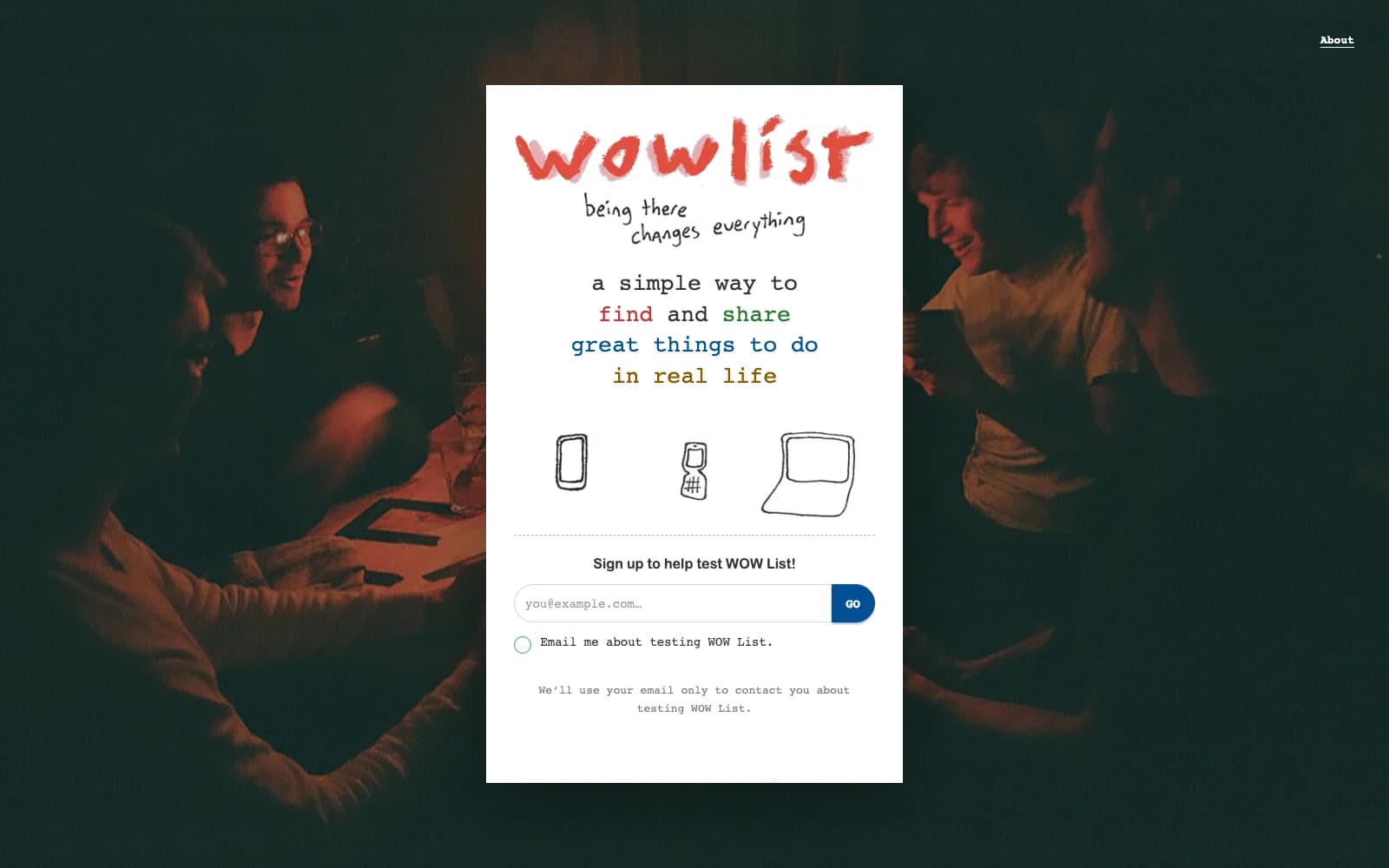
WOW List is returning one deliberate step at a time. Its current live, noindex public threshold restores a recognizable landing page, an About page, and a consented tester invitation—not yet the community calendar itself.[1]
Product decision
The product decision was intentionally light: rather than force organizers through a complex event form, WOW List treated each post as collaboratively editable natural-language text. Natural-language processing and followable keyword communities turned that writing into event distribution, profiles, followed lists, and weekly email.[5][3]
What was unclear
Organizers needed lightweight ways to share events without depending on one editorial gatekeeper or a single static calendar. Communities were often organized by interest, place, venue, scene, and informal networks rather than clean institutional categories.
What became usable
The platform turned keywords into followable community surfaces. That gave organizers a way to publish and distribute events around the language their communities already used.
A July 2017 production snapshot documents WOW List activity across 35 city ecosystems, supporting local organizers who used the platform to run calendars, websites, and email lists for their scenes.[2]
WOW List's complete recovered public-account population preserves the project's social origin and operating texture: the first authored post credits Richard and Jamie and connects the platform to Sunday Dinner calendars; support threads explain joining, publishing, profiles, followed lists, and weekly email; and independent organizers published a tutorial and linked local event calendars through the system.[3][4][5][6][7]
The combined record supports Jamie's account that Call Script became one bridge from WOW List's popular.vote calendar into early NYC Artist Coalition organizing: Jamie publicly mobilized for the January 2017 DCLA meeting; its discussion ran a participatory naming poll in which ‘NYC Artist Coalition’ displayed 57%; and Call Script then promoted the coalition's next general meeting.[8][9][10][2]
A public 2016 event page for the 200th Sunday Dinner links directly to its WOW List event page, preserving one concrete route from the recurring gathering into the community-calendar platform.[11][12]
What I did
Jamie co-built and supported the product model, event workflows, and public-facing web system. The work connected community organizing patterns to a maintainable technical platform.
Product practice in one view
WOW List provides unusually broad evidence of Jamie's product practice: Jamie and Richard Caceres co-built a working community-calendar service, and Jamie's documented work connects product definition and implementation with participatory discovery, organizer adoption, public communication, historical production instrumentation, and long-term stewardship.[2][3][4][5]
The evidence forms one connected product story: calendars made with Sunday Dinner clarified the problem; followable keyword communities made that need buildable; and public support and organizer materials helped people join, publish, and maintain local calendars across 35 city ecosystems.
Transferable proof
This is product-operations and public-web proof: community vocabulary, user workflows, platform logic, and distribution needs had to become a system that real organizers could use.
Sources and notes
These notes preserve what each source supports and where its limits remain. See something that needs correction? Contact Jamie.
View 12 source notes
[1] WOW List public landing and About pages, with tester-interest invitation, accessed August 13, 2026.
The inspected surface was deliberately small and noindex; it did not expose a restored calendar or private historical corpus.
Boundary: This source does not establish restored calendar, active membership, current adoption, completed relaunch.
The control file preserves reproducible aggregate facts and boundaries while excluding raw database rows, private workbook rows, identities, and authenticated-session data.
Boundary: This source does not establish current product activity, unique Sunday Dinner participants or precise attendance, sole authorship or sole coalition founding, endorsement, mandate, conversion, causality, or policy impact.
[3] WOW List X full-population and engagement manifest, July 15, 2026.
A public-safe 38-row manifest with resolved URLs, defined classifications, named public repost identities, and external-adoption examples; raw post bodies and session data are excluded.
Boundary: This source does not establish a complete product archive, a complete lifetime engagement census, individual post authorship, current product availability, formal institutional adoption.
[4] WOW List, first recovered authored post, February 12, 2014.
The post credits Richard and Jamie and connects the project to calendars made at Sunday Dinner.
Boundary: This source does not establish sole authorship, complete collaborator roster, platform scale, current availability.
[5] WOW List public product-support thread, September 1, 2016.
The thread describes the project as growing from Sunday Dinner and explains historical user workflows.
Boundary: This source does not establish current service availability, complete feature history, individual authorship of every platform component.
[6] Shelby Turner, 'SHELBY'S WOWLIST TUTORIAL - for my new fave events website,' YouTube, 2015.
Public video metadata and the account post identify an independently published WOW List tutorial.
Boundary: This source does not establish complete tutorial contents without transcript review, platform-wide adoption, formal partnership, Jamie's authorship, current product availability.
[7] Santa Barbara DIY resource page, accessed July 15, 2026.
The page directs visitors to add events to the wowlist.org/sbdiy calendar and links its WOW List page.
Boundary: This source does not establish current WOW List availability, usage volume, formal partnership, Jamie's individual role, city-ecosystem scale.
[8] Call Script public Facebook Page, accessed July 15, 2026.
The current Page displays a representative-calling tagline, popular.vote as its project link, and a post promoting the March 2017 NYC Artist Coalition general meeting.
Boundary: This source does not establish who authored every historical post, when the current profile link was added, sole ownership of Call Script or NYC Artist Coalition, attendance or outcome.
The page preserves organizer displays, a Call Script coalition-name poll, a collaborative DCLA-letter action, and mutable response and self-reported reach signals.
Boundary: This source does not establish complete vote count, attendance, unique people, sole founder or legal founding act, authorship of every task or letter line, endorsement, mandate, conversion, causality, or policy impact.
Jamie invited New Yorkers to pack the meeting in support of DIY spaces and improve-dont-evict responses.
Boundary: This source does not establish sole event production, attendance, agency endorsement, policy outcome, authorship of every Call Script or coalition post.
[11] '200th Sunday Dinner! Special! Wow! Amazing! Interesting!,' Facebook event, June 26, 2016.
The public event page names Julia Fredenburg and Jamie Burkart as co-organizers, presents the event as the 200th Sunday Dinner, and links to a WOW List event page.
Boundary: This source does not establish an independent audit of 200 gatherings, attendance, sole production by Jamie, the complete Sunday Dinner history.
Accounts for all 511 personal-profile event-card instances and the zero-card current WOW List owner surface while identifying only 21 selected public Jamie-attributed events.
Boundary: This source does not establish a complete native Meta export, Jamie's role in profile-associated events without explicit attribution, physical attendance or unique reach, sole event authorship or production, historical nonexistence from an empty current surface.
Primary artifacts
- website
- workflow
- prototype
Artifact gallery
website / 01
Recognizable public return threshold
A live landing page, About page, and consented tester invitation restore the original public promise without pretending that the community calendar is already back.
diagram / 02
Keyword-community model
A lightweight distribution pattern for followable arts, music, and local-interest communities.
Scope and sources
Known
Jamie and Richard Caceres co-built a natural-language community-calendar platform organized around followable keyword communities, and a deliberately small public return threshold is live now.
Open
The contemporary calendar, contribution model, governance, moderation, retention, and broader relaunch sequence remain open product work.
Protected
Private user data, organizer contact lists, and unapproved community records are not published.
Source basis: Live public landing and About pages, source-backed project memory, Jamie's public-safe product-design account, historical public-safe aggregates, and private member and introduction records intentionally omitted.
Claim and care limits
The live surface is a noindex tester threshold, not the restored calendar. Historical scale remains a dated 2017 snapshot, and private company, member, or archival material stays offline.
Public links
Credits
- Jamie Burkart
- Richard Caceres
- WOWList organizers, editors, facilitators, maintainers, and participants